Personal Pride
from Some Guy Says

This is my earliest memory.
I am right at a year old. I am not quite walking, but I can pull myself up to a stand. I think my family must be moving out of our house in Falls Church, and my parents have placed me in the corner of an empty room where I should be out of harm’s way.
I know exactly what I am wearing: it is one of those corduroy overall getups that babies wear to this very day. Mine is powder blue, and there is some red embroidery outlining something or other – a rabbit maybe? – at the knee.
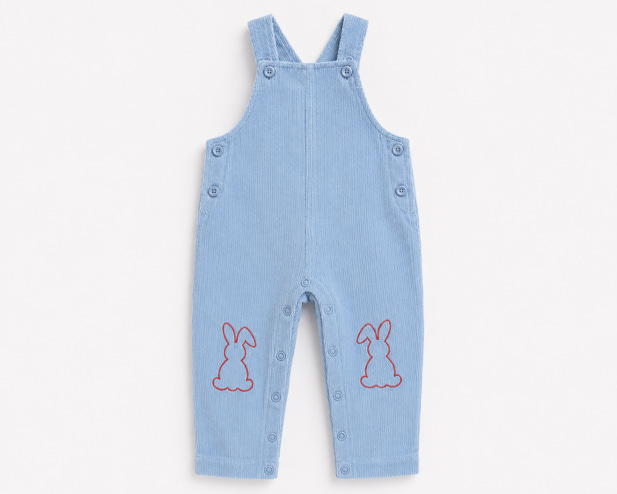
I am fascinated by the snaps that go up and across the inside of the legs. As I play with them, I discover that I can unsnap them. I pull myself up and see the legs of the overalls flopping around my own, so I start a clumsy dance. It is a delightful feeling and a wonder to watch the legs of the overalls swish around me. I am so happy.
Maybe I am giggling and squealing. That must be what has called my mother back into the room. I watch her expression change from concern to exasperation as she huffs her way over to me and firmly sits me down and snaps me back up again.
She leaves the room. She has things to do.
I unsnap the britches and stand up and dance while holding onto the wall.
This is how she finds me again. She is not pleased. This time she plops me down and snaps me back up. How many times has she had to do this?
I don’t remember if I unsnapped and stood up and danced again. I think I was starting to pay attention, starting to understand some basics about cause and effect.
In a way, it has been the story of my life. I’m feeling loose and amorphous and wonder and delight, and then I get — or maybe I let myself get — re-ordered again.
Plop. Snap.
You know?
When I was two and three, my family – now with baby sister Lizz in tow – lived in Naples, Italy. I am told that my first language was Italian which makes sense since both of my parents worked out of the home, and we were left in the care of an older non-English speaking Italian couple who lived on the floor below. I don’t remember any Italian, but I do remember finding my mother’s maternity blouses as she was pregnant then with sister Doris. I remember creeping into them and twirling all over the bedroom that Lizz and I shared. I loved the way the fabric billowed and swirled around me. I loved the way it moved the air and made me feel like I was not inside my body.
Mother was gone somewhere. Traveling. We were left with Dad. He would find me in one of those blouses and, well, that was real trouble. I mean...Really Bad Trouble. I am paying very close attention. I am learning a lot about Trust.
An awful lot.
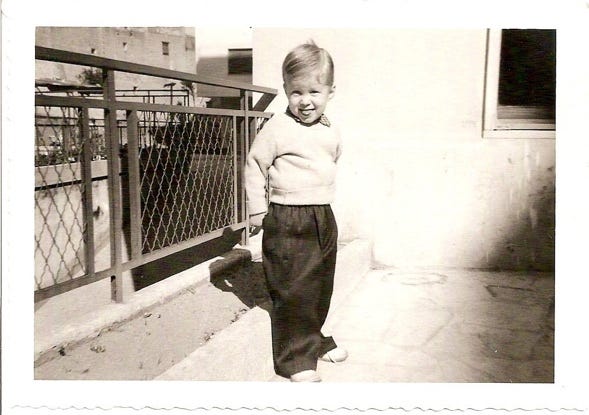
Fast forward a couple of years, I am four. We are living in Norfolk, VA, and vacationing in nearby Virginia Beach. We are in a small hotel room that has an actual black and white television set. The beach is fun, but the TV is astounding! Especially the commercials. I remember particularly the commercials with Mr. Clean. I did not have a sexual understanding of myself then – I mean, I was four years old fer cryin out loud – but I am frozen in front of this cartoon muscle man with a golden hoop earring wearing capri pants —
Mercy.
So.
Here you go.
Three memories of early childhood. I’ve got plenty more, believe you me. But there’s one in particular I think I need to share to make this story complete.
So. When I was like 10-11-12, right? I really really wanted to be a girl.
I would go to bed every night and I would pray: Dear Lord Jesus please please please let me wake up as a little girl and — please please please, Sir — if You are going to go to all the trouble to flip my gender in my sleep, please let the results be unremarkable!
Well. In hindsight, I can’t say for sure that I really really wanted to be a little girl. I think that what I really really wanted was to normalize my feelings about men because I didn’t understand them — the feelings. I totally get men. But I elsewise felt awkward and weird and not in my skin and-and-and if I were a little girl maybe I could grow up and marry Mr. Clean!
See?
In any case, and at the end of the day, it didn’t matter because I turned 13 and hit puberty, and then my prayer was, like, Hey Jesus: no worries, I’m good!
To be sure, there are other kinds of memories, too, “non-gay” memories like fun family vacations, amazing travels in the world, academic and professional achievements, deep and glorious friendships with boys and girls, men and women, high times and low, scary times that I came through, and so much more.
In fact, it is inside these spaces that, as a small gay boy and a young gay person, that I chose to live. These were the spaces that I had painstakingly constructed so I could feel safe.
For most of high school, we lived in Hawai’i. I went to Hawai’i Baptist Academy. Here, we dated girls, made professions of faith, laughed at queer people, and, as queer kids, hid.
My parents told me that, as long as I made good grades and achieved some other prescribed benchmarks, I could have run of the island. So? Like a lot of queer kids, I constructed a safety net of good grades, a polite and deferential demeanor, a sort of attentiveness that demanded care, maintenance and unwavering attention to the details and interests of the others — the family and social and academic worlds I lived in — and, most importantly, drew no untoward attention to myself.
Or so I thought.
In my middle-ages I learned from high school gal pals that pretty much everyone knew I was gay even when I did not. Again, I had no language, no context, no place to put these feelings. All I knew was I was somehow different and, godalmighty, I did not wish to be.
Hard to believe but true nevertheless.
In an interview where she discusses her music, queerness, and identity, the singer/songwriter/multi-instrumentalist St. Vincent says: “Everything is a construct. It is all construct” which I take to mean constructed. She describes sexual identity as “performance,” not in the sense of deception but more in the sense of learning to read a room, to monitor yourself; deciding — being in charge of — what to reveal about yourself and when, and understanding that identity is largely contextual.
This part really hit me:
“Being queer means having multiple realities at once. I’m queer, so I know how to code-switch.”
Code-switch. I had never heard that term before, but I knew instantly what it meant. According to Wikipedia: “Code-switching is the practice of alternating between two or more languages, dialects, registers, or cultural behaviors depending on the social context of the audience. While it originated as a linguistic term to describe multilingual speakers blending languages, the definition has broadened in sociology to describe how individuals adapt their speech, appearance, and mannerisms to fit into different environments.”
So?
Code-switching was something I got really good at.
So good that...
When I was 36 years old, I finally came out to my parents. It never occurred to me that coming out to them was something I needed to do or even something that I could do. When I say that it wasn’t something I could do, I mean that in the sense of How do you reveal something to folks who [should] already know? How in the world did they miss that little gay dancing baby in twirling maternity blouses? What did they think those musicals – so many character shoes and dance belts – were all about? What about all the girls I never brought home? How, at a minimum, could they not have guessed?
How could they not know?
It made no sense.
I should say here, too, that among gay men my age who remained closeted from our parents in those days (80s, 90s), it was common to hear folks/us say, Why should I tell them I am gay? They never told me they are straight!
Except they did.
Every day. All the time.
Every private whisper, every slide of a finger into a hand held, the way she made his coffee, the way he turned out the lights and shut the house down at night, even every argument over the dinner table and the ways they found to navigate again toward each other, everything said to me that my parents were straight people who loved each other.
I wanted access to those gestures, too. I wanted something unconstrained and — this is very important — unremarkable.
By this time, too, my walk in the world was pretty queer, and I was elsewise very much at ease with myself as a gay man. I didn’t hide it, but I also did not think of my own self as a gay person fundamentally. I was a lot of other things. Important things. Fancy things. I was Robert and Mary Anne’s son with an amazing middle name to live up to, a teacher to your little darlings, a colleague, a cultural and civic leader (so I am told), an award winning actor, director and performance artist, a storyteller in partnership with a beloved lesbian percussionist. A powerful code-switcher.
All of these things point to...gay. Right? Even/especially that part about Robert and Mary Anne: remember that dancing baby?
So.
I thought it would be easy – which is to say that I did think it would be weighty and important but not necessarily hard – to have this conversation with my parents.
You see, my plan was never to come out per se but rather to tell them about a really wonderful man and our powerful relationship that I wanted them to celebrate with me, with us.
Hoo-boy.
Here’s the deal: that timing is never right. You know? So I put myself on a deadline to have this talk with them. And I learned right quick that the time is never going to be right to tell your Southern Baptist parents that you are gay. Or in love with a man. Or, goodness me, all kinds of queer things. Like the way my happy queer dancing childhood were among the very things that made me so, so happy.
I waited til the very last minute of my self-imposed deadline. And I got nervous. I scripted myself. I didn’t want to be distracted. I also wasn’t sure I wanted to have to look at them. Not sure I could. When I did sneak a glance, I don’t recall their looking at me. I see them looking at each other.
It was awful.
Anyway.
I read a letter to them.
It was crystal clear that what I had brought forward to my parents was a full-on bolt out of the blue. There were long silences, even tears. I got angry that, at my age and against everything else I had thought and done and been and accomplished, I hadn’t been seen. I believed I had done a lot of this for them…
But…
Maybe I was just a better code-switcher than I thought?
Right?
Because at the end of the day, being gay is fundamental. It’s like air. It is just that basic. You just breathe; you don’t think about it…until you do. Like when you have to hold your breath. Absent of anything else, it is how you see the world and everything in it because it is who you are. In this regard, it is unremarkable.
Straight people, you do it, too — it is how you see the world, how you walk in it without even thinking about it.
Ever.
Anyway.
It took a very long time for the three of us to find our way back towards each other. And oddly, it was my high-ranking navy dad who made the first effort toward healing. He asked about Bruce. He was interested when we bought the house and gave good advice on negotiating a mortgage and managing a household and what to plan for.
Mother took a lot longer. A lot. Years. But she got there.
There is so much I’m leaving out because, honestly, there’s not much in this life that is more tedious than having to endure someone else’s coming out story. I mean…how is this still even an issue, a thing? Interesting? Useful? Relevant?
Well, I’ll tell you.
The politics of the day make it important. Are you paying attention? That othered people are being driven back into the shadows makes these stories useful, relevant, and important. Gay people, gay families – children and parents and all of us – are plainly under attack. This is important. It has never in my lifetime been harder for gay adults to model practical survival skills, let alone excellent behavior, for scared queer kids. I wonder how I’m going to let them know that “It gets better” than it is right now because I cannot be sure that it does or that it can or that it will.
This is very important.
But here’s the deal: I do remember driving home from that coming-out meeting with my parents in April 1993. Unlike that little gay baby, I don’t remember what I was wearing, but I remember asking myself very clearly and distinctly:
What am I going to do with all this personal power I have just given to my own Self?
I think about this all the time.
I wish you all, today and for the days to come, a very Happy Pride.
Some Guy Says is written by Robert Arleigh White and distributed via Substack twice a month — give or take — and benefits mightily from the editorial support provided by Canetha Dodd — to whom and for which I am truly grateful.
You can subscribe for FREE!!
But…
Please consider a paid subscription. It supports this work and creates opportunities for others. Paid subscriptions start at just $5/month! Woohoo!
Keep dancing, dear friend. Thank you for writing this. I think of little side-glances. Subtle reminders of the obvious albeit unnecessary gulf between us and them. So much time wasted. Is making someone feel badly about being themselves the ultimate unkind act? Emotional genocide? Kinda?
At any rate, I’m proud to be your friend. Thank you for sharing from your heart.
Let’s pledge this month to help make the “others” feel comfortable in the skin they are born in.
Thanks for sharing. I read this not knowing you were the Bob I was reading about until the ending. It’s shameful that today’s regime in the WH hasn’t evolved and wants to destroy what progress has been made on many human fronts.